Learning Outcomes in Listing:
i. Comprehend the significance of oxidation-reduction reactions in energy transfer within living systems.
ii. Understand the role of ATP as the primary energy currency in cells.
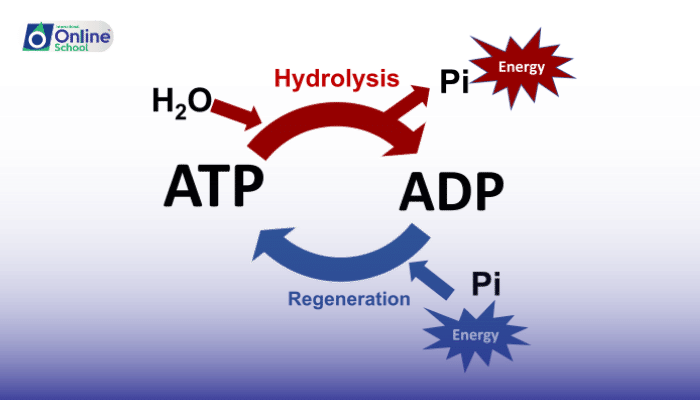
iii. Describe the ATP-ADP cycle and its role in energy synthesis and utilization.
Learning Outcomes Described:
Students will explore the crucial role that oxidation-reduction (redox) reactions play in the flow of energy through living organisms. They will understand that ATP is the main energy currency of cells, essential for driving various biological processes. The lesson will also cover the ATP-ADP cycle, revealing how cells create and use energy in a continuous loop of synthesis and degradation.
Summary of Lesson:
Oxidation-reduction reactions are the driving force behind the movement of energy in biological systems, crucial for sustaining life. ATP, adenosine triphosphate, stands at the heart of cellular energy exchange, providing the power needed for numerous cellular functions. This lesson will focus on how ATP is synthesized and utilized through the ATP-ADP cycle, maintaining the energy balance within the cell.
i. The Role of Oxidation-Reduction Reactions:
These reactions involve the transfer of electrons from one molecule to another, facilitating the conversion of energy within cells.
They are integral to processes like cellular respiration, where the oxidation of glucose translates into the energy needed for ATP synthesis.
ii. ATP: The Energy Currency:
ATP is the molecule that stores and provides energy in a form that cells can readily use. It powers vital processes, including muscle contraction, nerve impulse propagation, and chemical synthesis.
Energy is released when ATP is broken down into ADP (adenosine diphosphate) and an inorganic phosphate, a reaction that occurs during cellular activities.
iii. ATP-ADP Cycle: The Energy Loop:
The ATP-ADP cycle is a continuous loop in which ATP is synthesized from ADP and inorganic phosphate during energy-releasing reactions, such as the breakdown of glucose, and then broken down back into ADP and phosphate when energy is needed.
This cycle is a critical component of energy regulation in cells, ensuring that energy is available when needed and conserved when it is not.
List of Important Questions for Self-Study:
i. Why are redox reactions essential in biological energy transformations?
ii. How does ATP store and release energy?
iii. What are the steps involved in the ATP-ADP cycle?
iv. Why is the ATP-ADP cycle considered to be an energy loop?
v. How might the malfunction of the ATP-ADP cycle affect a cell?
Important Terminologies Used in Lesson:
i. Oxidation-Reduction Reactions: Reactions that involve the transfer of electrons between molecules, crucial for energy conversion in biological systems.
ii. ATP (Adenosine Triphosphate): The primary energy carrier in all living organisms, which stores and transfers energy.
iii. ADP (Adenosine Diphosphate): A lower-energy molecule that can be converted back into ATP.
iv. ATP-ADP Cycle: The process by which cells regenerate ATP. ADP gains a phosphate group to become ATP, which can then be broken down again when energy is needed.
